
Trump: Iranians Do Not Know Who Their Leader Is
Al-Taj News – U.S. President Donald Trump said Monday that Iran is a failed state, but that does not mean the United States will not strike it.
Trump told reporters that inflation in Iran had reached 350%, and that it was also not paying soldiers’ salaries, noting that most of the Iranian leaders had been killed and that the navy was finished, as was the air force.
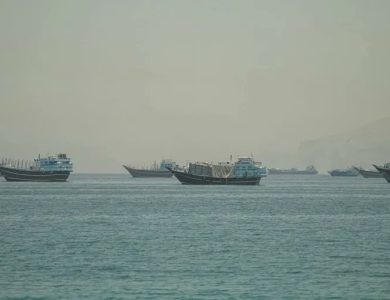
Regarding the Strait of Hormuz, the U.S. president confirmed that the strait is in very good condition, with 30 ships carrying large quantities of oil passing through every night, which prevented oil prices from rising. He noted that China had remained neutral regarding the strait.
He stressed that Iran would never obtain a nuclear weapon, saying, “If Iran gets a nuclear weapon, it would wipe Israel off the face of the Earth, and Israel would not exist now, nor would the Middle East, and at some point they would strike our cities because they are sick, and Iran will never get a nuclear weapon.”
Trump continued by saying that the Iranians do not know who their leader is, noting the existence of “extremists who have been killed militarily.”
The “Axios” website had quoted three U.S. sources as saying that the Trump administration was considering carrying out limited strikes in the Strait of Hormuz, with the aim of preventing Iran from rebuilding its radar and missile capabilities, which could be used to target ships.
According to the sources, U.S. Central Command developed the plan over the past week, and it received the support of U.S. Secretary of War Pete Hegseth. However, Trump had not approved it before the latest exchange of fire with Iran, while he may approve it following the new escalation.
A U.S. official said the aim of the plan is to reduce the risks of Iranian attacks on oil tankers, U.S. Navy ships, and Air Force aircraft, describing it as an attempt to repeatedly “mow the grass” to prevent Iran from rebuilding its military capabilities.
The White House said that “the president retains all options available to him,” adding that “the Iranians want to reach an agreement, but they are always a day late and lack the resources.”
Over the past two months, the U.S. military has strengthened its control over most of the Strait of Hormuz through operations aimed at weakening Iranian military capabilities, clearing mines, and guiding ships through the strait.
These operations have reduced Iran’s ability to target oil tankers, alongside an increase in ship traffic and oil exports through the strait, weakening Tehran’s influence over this vital waterway.
According to U.S. officials, U.S. Central Command has expressed concern over Iran’s efforts to rebuild its radar, air defense, and anti-ship missile capabilities in the strait, which would allow it to target ships more accurately.
A U.S. official said one of the incidents that raised concern in recent days involved an Iranian anti-aircraft missile being launched toward a U.S. F-35 fighter jet that was providing protection for ships in the strait.
He explained that the missile did not come close enough to pose a threat to the aircraft, but it was considered an indication of Iran’s attempt to rebuild its military capabilities.
Over the past several days, U.S. Central Command informed Hegseth, Chairman of the Joint Chiefs of Staff General Dan Caine, and the White House that the U.S. military might need to carry out periodic strikes against Iran, with the aim of continuing to allow dozens of oil tankers to leave the Gulf safely each day.
According to U.S. officials, Hegseth supported the plan and sent it to the White House several days ago, while the U.S. administration had been inclined last week not to approve the strikes in order to avoid further escalation with Iran.
The Iranian attacks came after the United States targeted Iranian forces that were preparing to launch missiles loaded with mines toward the strait.
Trump told Fox News on Monday that the United States would respond to the Iranian attacks, threatening to “hit them hard.”